


 Posts
Posts


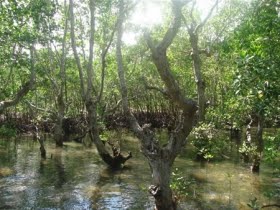
Coastal mangrove forests store more carbon than almost any other forest on Earth, according to a study conducted by a team of U.S. Forest Service and university scientists.
Their findings are published online in the journal Nature Geoscience.
A research team from the U.S. Forest Service's Pacific Southwest and Northern research stations, University of Helsinki and the Center for International Forestry Research examined the carbon content of 25 mangrove forests across the Indo-Pacific region and found that per hectare mangrove forests store up to four times more carbon than most other tropical forests around the world.
"Mangroves have long been known as extremely productive ecosystems that cycle carbon quickly, but until now there had been no estimate of how much carbon resides in these systems. That's essential information because when land-use change occurs, much of that standing carbon stock can be released to the atmosphere," says Daniel Donato, a postdoctoral research ecologist at the Pacific Southwest Research Station in Hilo, Hawaii.
The mangrove forest's ability to store such large amounts of carbon can be attributed, in part, to the deep organic-rich soils in which it thrives. Mangrove-sediment carbon stores were on average five times larger than those typically observed in temperate, boreal and tropical terrestrial forests, on a per-unit-area basis. The mangrove forest's complex root systems, which anchor the plants into underwater sediment, slow down incoming tidal waters allowing organic and inorganic material to settle into the sediment surface. Low oxygen conditions slow decay rates, resulting in much of the carbon accumulating in the soil. In fact, mangroves have more carbon in their soil alone than most tropical forests have in all their biomass and soil combined.
Mangroves Among the Most Carbon-Rich Forests in the Tropics; Coastal Trees Key to Lowering Greenhouse Gases
Friday, April 8, 2011
Labels:
Global Warming
0
comments

Arrest Global Warming
Sunday, October 3, 2010
Global Warming Facts

Global warming is caused by green house gases, which trap in the sun’s infrared rays in the earth’s atmosphere, which in turn heat up the earth’s atmosphere. These green house effect warming is called as global warming. The effects of green house effect are visible more prominently in the recent years, with number of natural calamities on the rise in the whole world.
The global warming has happened in the past few years and is evident from the rise in mean temperature of the earth’s atmosphere. The main causes for the global warming are attributed to release of green house gases by human activities. The main gases contributing to green house effect are carbon dioxide, water vapor, methane and nitrous oxide. The largest producers of these gases are the thermal power plants, which burn the fossil fuels and produce these gases in large quantities. The second biggest sources of these green house gases are the road vehicles and industries.
The global warming has led to increase in mean earth surface temperature and thus melting of polar ice. There are frequent melt down of glaciers that result in floods and other natural calamities. The melting of ice at the poles had led the mean sea level. And further increase in temperature may further melt the ice and lead to further increase in mean sea level, which will engulf low lying countries.
The effect of global warming is very evident on the animal kingdom also. Some animals have become extinct due to loss of their natural habitat or their inability to evolve to the rapid changes in the climate. Also there is a change in their life style because of the changes in the seasons. The migrating birds have changed their time of travel and also their place of migration.
The effect of global warming can be felt on seasons too. There is shift in season cycle, as the summers are getting longer than the winters. This has affected the animals and made them to change their lifestyle accordingly, and those who failed to do so have perished or on the verge of extinction.
The global warming is also responsible for the introduction of some new diseases. The bacteria are more effective and multiply much faster in warmer temperatures compared to cold temperatures. The increase in temperature has led to increase in the microbes that cause diseases.
Global warming is also effecting the crop production, as the crops are getting destroyed by the sudden change in temperatures or sudden on set of rains. Also the flash floods and other natural calamities affect the crop.
As a matter of fact, because of global warming, the earth’s atmosphere is getting more unpredictable with heavy rains in the areas, which have scanty rainfall or drought in the areas, which received good annual rainfall. The months of rainfall has also getting affected.
But there are some people on the other side of the wall also, they believe that the global warming is a natural process and cannot disturb our ecosystem. The earth’s surface mean temperature was even higher a long time ago, and the ecosystem has evolved from that temperature to this. So it can evolve further. But the changes that are happening now are rather fast compared to earlier times.
Labels:
Global Warming
0
comments
